Thracian Tomb of Aleksandrovo and Its Hunting Frescoes
The Thracian tomb of Aleksandrovo is a burial mound with a painted chamber, dated to the 4th century BCE, near the village of Aleksandrovo in Haskovo Province, in south-eastern Bulgaria. Its frescoes of hunters, banqueters and a mysterious axe-bearer rank among the great finds of Bulgarian archaeology. The original is closed, but an exact replica can be visited nearby.
Bulldozers uncovered this tomb by accident in December 2000, and inside archaeologists found a painted hunt so lifelike that even the stitching of the clothes is shown.
The history of the Thracian tomb of Aleksandrovo
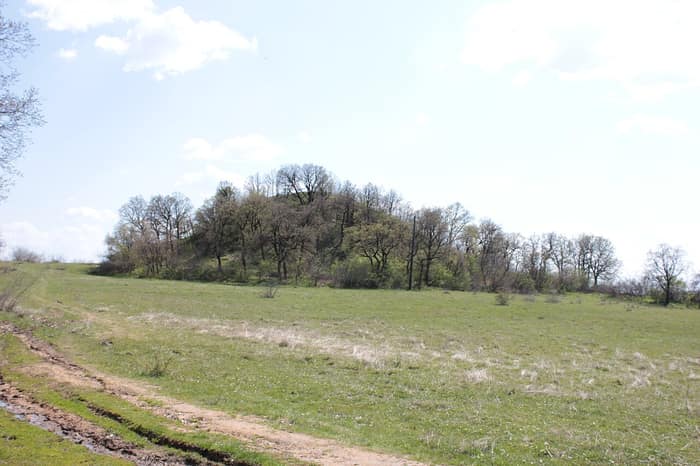
The land around Aleksandrovo, a village that was once called Korudzhievo, lies in hilly country a few kilometres south of the Maritsa river. It is packed with monuments from many ages: the hill known as Hasara, with the remains of an ancient and medieval fortress, is ringed by Thracian burial mounds, and about twenty-one of them are counted in the area. Many were damaged by treasure hunters, who for generations were drawn by local tales of hidden gold.
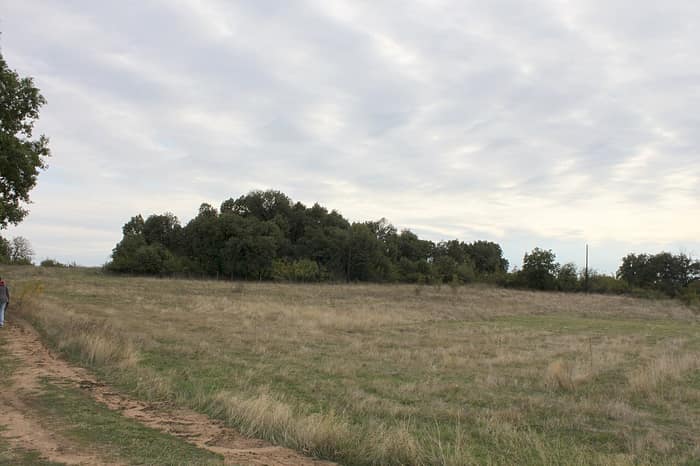
One of these mounds, the large Roshavata chuka, stands about 15 metres high and 70 metres across. Inside lay a tomb dated to the 4th century BCE, probably the early part of it. It was built for a Thracian king or a high-ranking aristocrat, and the walls and floor show that the monument was used in at least two phases. The chamber is round with a bell-shaped vault, and it is reached by a long stone corridor and a small rectangular antechamber. Its stone blocks are laid without mortar, and a heavy two-leaf stone door once closed the burial room. A stone ritual bed stood inside, though it had been broken up by the time archaeologists arrived.
The tomb came to light on 17 December 2000. An earth-moving machine is said to have exposed it by accident, and looters then got in and damaged some of the paintings. The archaeologist Georgi Kitov and his team reached the mound as freshly dug earth showed, entered through the opening and found a chamber with remarkably well-preserved frescoes. Rescue excavations continued until 2003, and the discovery is counted among the greatest of Bulgarian archaeology.
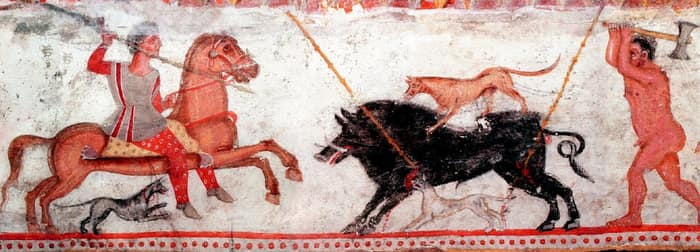
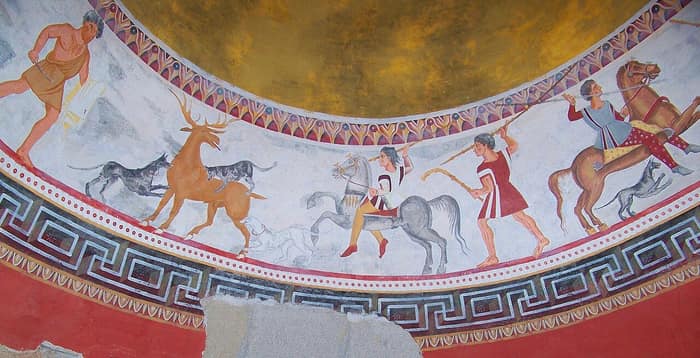
The painted decoration covers the round chamber, the antechamber and part of the corridor. In the main chamber it is arranged in horizontal bands. A funeral banquet shows a bearded man being served wine and a seated couple with joined hands. Above it is a frieze of a royal hunt, only 38 centimetres high, in which riders on grey, yellow, white and red horses and men on foot attack wild boar and deer, helped by around ten dogs. A naked man swings a double axe, a royal symbol, and he is usually read as the god Zalmoxis; other scholars suggest an ancestor of the dead man or even Herakles. The artist knew Greek art of the late Classical and early Hellenistic period, and the clothes, boots and weapons are painted down to the seams.
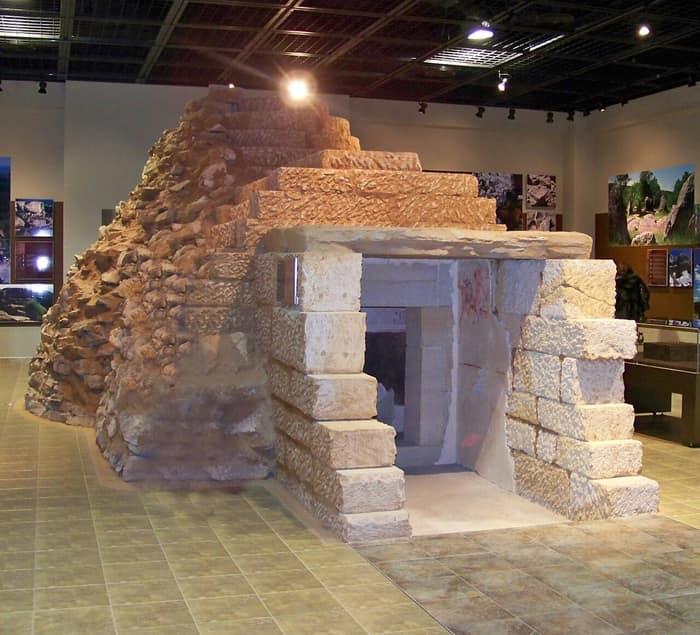
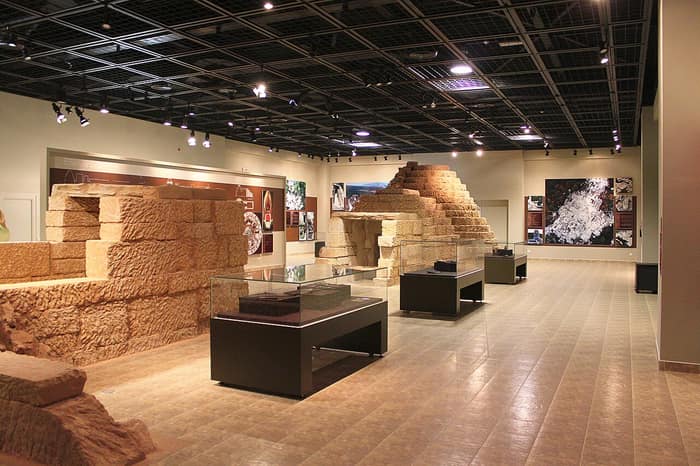
A scratched drawing of a young man in profile, with a Greek-letter inscription reading Kozemases, is probably the name either of the patron or of the painter; Kitov saw it as the artist's self-portrait. After the discovery the original tomb was closed to protect it. A full-size replica was built in the Museum Center of Thracian Art in the Eastern Rhodopes, opened in May 2009 with Japanese aid. In 2021 the tomb and the museum centre together received the European Heritage Label, the first Bulgarian site to do so.
Curious facts about the Thracian tomb of Aleksandrovo
- The tomb was found by accident: on 17 December 2000 an earth-moving machine is reported to have uncovered it, and looters entered soon afterwards.
- The painted name Kozemases, scratched beside a young man in profile, could mark the patron or the painter; the excavator Georgi Kitov believed it was the artist's self-portrait and signature.
- The hunting frieze is only about 38 cm high, yet it runs all the way round the dome with no start or end, and is read as the life cycle of the king.
- At the very top of the dome a painted disc is split into sectors, with red standing for sunrise and life and black for sunset and the underworld, and two narrow sectors forming a double axe.
- The naked axe-wielder in the hunt has been interpreted as the Thracian god Zalmoxis, an ancestor, or Herakles; scholars still disagree.
- The tomb and its museum centre were the first Bulgarian site to receive the European Heritage Label, in 2021.
Tours near Thracian Tomb of Aleksandrovo
Experiences in the area that you can book online with Viator:

Valley of the Thracian Kings, Hidden Treasures
See details ›
Kazanlak-Rose Valley-Valley of the Thracian Kings - private tour from Plovdiv
See details ›
A Day trip to the Thracian Kings, The Valley of Roses & Buzludzha
See details ›
Thracian Valley wine tasting - private day tour from Plovdiv
See details ›Visiting the Thracian tomb of Aleksandrovo
- The original tomb inside the mound is closed to visitors to protect its frescoes, so visits focus on the replica in the Museum Center of Thracian Art in the Eastern Rhodopes, about 150 metres north of the mound.
- The replica shows the corridor, the antechamber and the round chamber with their hunting and banquet scenes, in the same architecture as the original.
- Look around the mound itself: the area around the hill of Hasara holds many other Thracian burial mounds, though some have been damaged by treasure hunters.
- Check the current opening hours and visiting conditions of the museum centre before you go, as they are not given here.
- The Perperikon rock city (about 37 km away) and Mezek Fortress (about 39 km) can be combined with a visit.
Opening hours, access and conditions can change. Check before you go.
Map: where Thracian Tomb of Aleksandrovo is
Photos of Thracian Tomb of Aleksandrovo
Questions
What is the Thracian tomb of Aleksandrovo?
It is a Thracian burial mound with a painted tomb chamber, dated to the 4th century BCE, near the village of Aleksandrovo in Haskovo Province. Its frescoes show a banquet and a royal hunt.
Can you go inside the original Aleksandrovo tomb?
No. The original has been closed to visitors to protect it, but an exact replica stands in the Museum Center of Thracian Art in the Eastern Rhodopes, about 150 metres from the mound.
Where is the Thracian tomb of Aleksandrovo?
It lies near the village of Aleksandrovo, about 19 km north-east of Haskovo in south-eastern Bulgaria.
Who was buried in the tomb?
The sources say a Thracian king or a high-ranking aristocrat. One suggestion is that it belonged to the Triballi, but the identity is not settled.
What does the name Kozemases mean?
It is a Thracian personal name scratched in Greek letters beside a portrait. It may refer to the tomb's noble patron or to its painter, and scholars disagree.
What else is worth seeing near Aleksandrovo?
The rock city of Perperikon is about 37 km away and Mezek Fortress about 39 km. Vishegrad Fortress is about 49 km away.
Also nearby
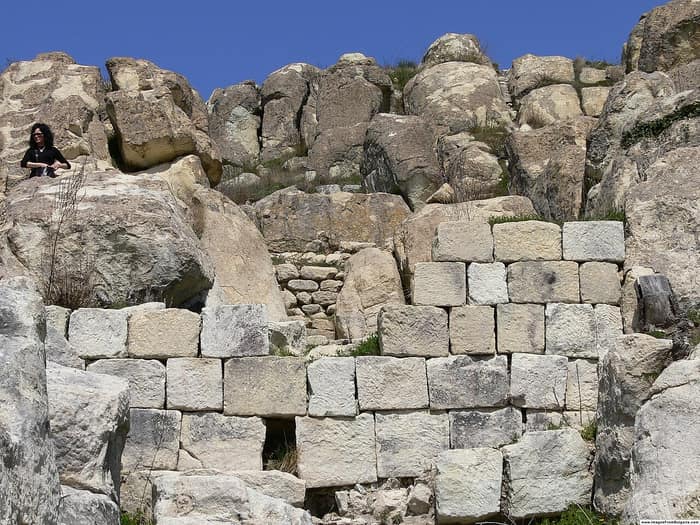
Perperikon
Kardzhali · rock-cut Thracian city and Balkan megalith giant
37 km away
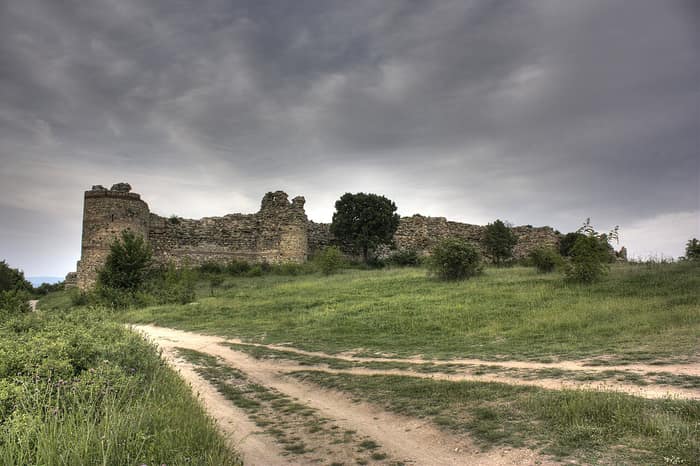
Mezek Fortress
Svilengrad · medieval fort with nine round towers
39 km away
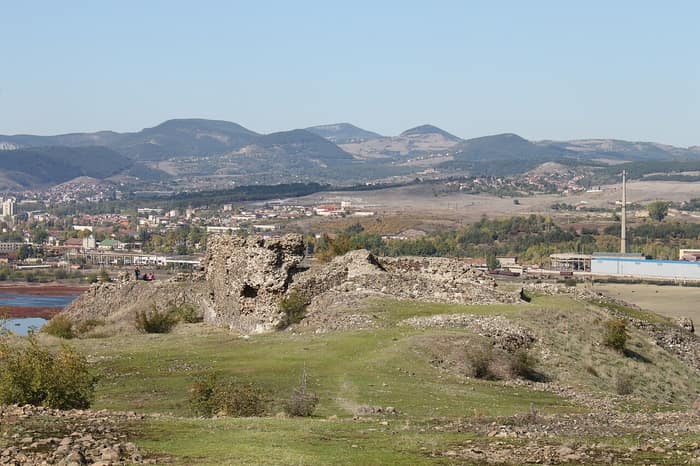
Vishegrad Fortress
Kardzhali · medieval fortress with a Thracian fort next door
49 km away
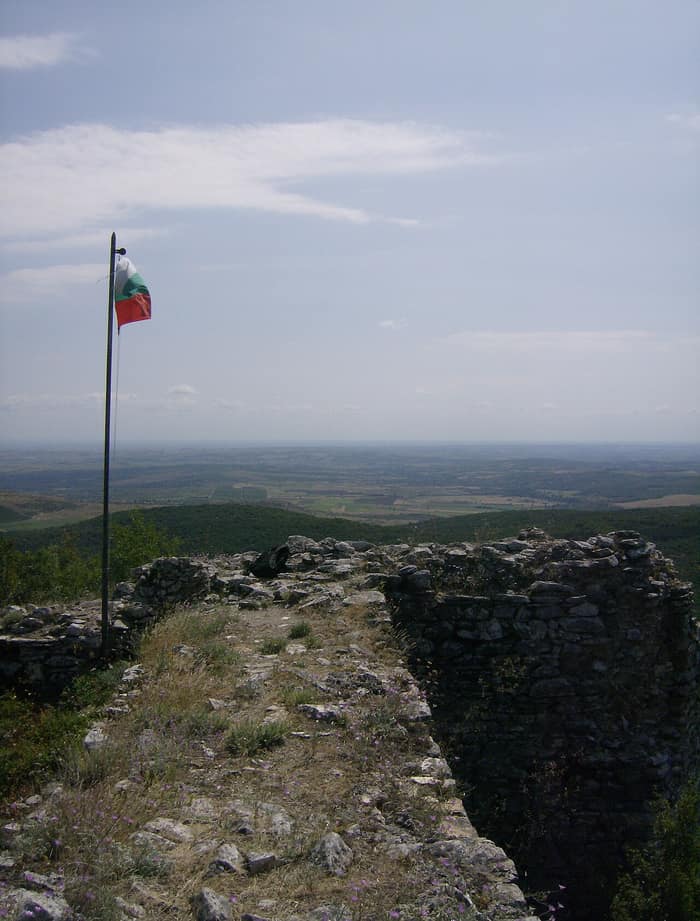
Lyutitsa
Ivaylovgrad · white marble fortress deep in the Rhodopes
60 km away